


CO6: Cardiovascular Regenerative Therapy and Applied Proteomics
CO6: Cardiovascular Regenerative Therapy and Applied Proteomics
The group consists primarily of basic researchers, but also includes clinical researchers specializing in primary care and internal medicine, all of whom are collaborating on the ongoing Projects .
Our work focuses primarily on studying the mechanisms of action of various cell types (endothelial progenitor cells, regulatory T cells, mesenchymal cells) with the aim of applying them as cell therapy for atherosclerosis and, more specifically, for peripheral arterial disease of the lower extremities (PAD).
To this end, we conduct in vitro assays to characterize the molecular mechanisms by which these cells are activated in response to atherosclerotic environments, using proteomic tools, as well as to determine their behavior in response to such environments through functional assays (proliferation, migration, angiogenesis), with the aim of modulating them and enhancing their regenerative (endothelial cells) and anti-inflammatory (Tregs) roles.
We also conducted in vivo experiments using an ICMI mouse model to evaluate the vascular regenerative potential of endothelial progenitor and mesenchymal cells. We used this same model with Rex-001 cells from the company Rexgenero. At this stage, we are evaluating the changes that occur as a result of ischemia as well as in response to cell therapy (restoration of blood flow, neovascularization, and arterogenesis). Additionally, we are conducting biodistribution studies to determine where the administered cells migrate, which is important in preclinical trials.
At the same time, we also use proteomic tools to identify biomarkers associated with cardiovascular diseases—primarily atherosclerosis—with the aim of developing protein panels that can detect patients at risk for thrombosis through routine testing, thereby preventing such events.
Responsible researcher
- María del Carmen Durán Ruiz:
- E-mail: maricarmen.duran@gm.uca.es
- ORCID: 0000-0003-3954-3734
Lines of research
- Line 1: Regenerative cell therapy for cardiovascular diseases.
╸Evaluation of the regenerative role of human endothelial progenitor cells as a cell therapy for atherosclerosis.
╸Evaluation of the role of regulatory T cells in atherosclerosis as an alternative cell therapy.
╸Cell Therapy for Peripheral Ischemia of the Lower Limbs (in murine models): Evaluation of the Regenerative Role of Human Endothelial Progenitor Cells.
╸Cell therapy for peripheral ischemia of the lower limbs (in mouse models): Evaluation of the regenerative role of bone marrow-derived cells (in collaboration with Rexgenero).
╸Cellular biodistribution studies in animal models.
- Line 2: Proteomics Applied to Cardiovascular Diseases.
╸Proteomic analysis of biomarkers associated with the atherosclerotic process. Identification and validation of associated biomarkers.
╸Search for diagnostic markers in patients with dyslipidemia.
- Line 3: Studies on the prevention of cardiovascular diseases.
╸Socioeconomic status and early markers of dyslipidemia.
╸Primary Care in Basic Research on Dyslipidemia and Cardiovascular Diseases.
Keywords
- # Cell Therapy
- # Cardiovascular Research
- # Regenerative Medicine
- # Biomarkers
- # Proteomics
- # Atherosclerosis
- # Peripheral Artery Disease
CO6: Cardiovascular Regenerative Therapy and Applied Proteomics
CO6: Cardiovascular Regenerative Therapy and Applied Proteomics
Responsible researcher
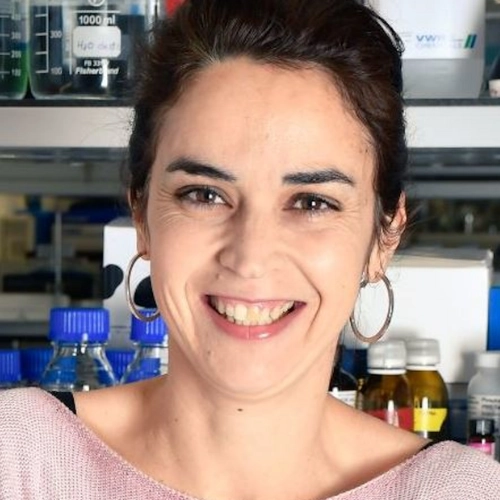
María del Carmen Durán Ruiz:
Assistant Professor (Ph.D.) in the Biochemistry and Molecular Biology Division, Department of Biomedicine, Biotechnology, and Public Health.
- E-mail: maricarmen.duran@gm.uca.es
- ORCID: 0000-0003-3954-3734
- Research ID: P-4175-2017
Members of the Team
- Principal Investigators:
- María del Carmen Durán Ruiz (PI).
- Researchers:
- Almudena González Rovira.
- Margarita Jiménez Palomares.
- Antonio Rosal Vela.
- María Calderón Domínguez.
- María Jesús Extremera García.
- Josefa Benítez Camacho .
- Isabel María Galeano Otero.
- Jorge Cabañas Penagos.

CO6: Cardiovascular Regenerative Therapy and Applied Proteomics
CO6: Cardiovascular Regenerative Therapy and Applied Proteomics
Production
Find all of the group's publications ( Projects, Patents , and Publications) on the I+Salud Portal of the Andalusian Public Health System:
