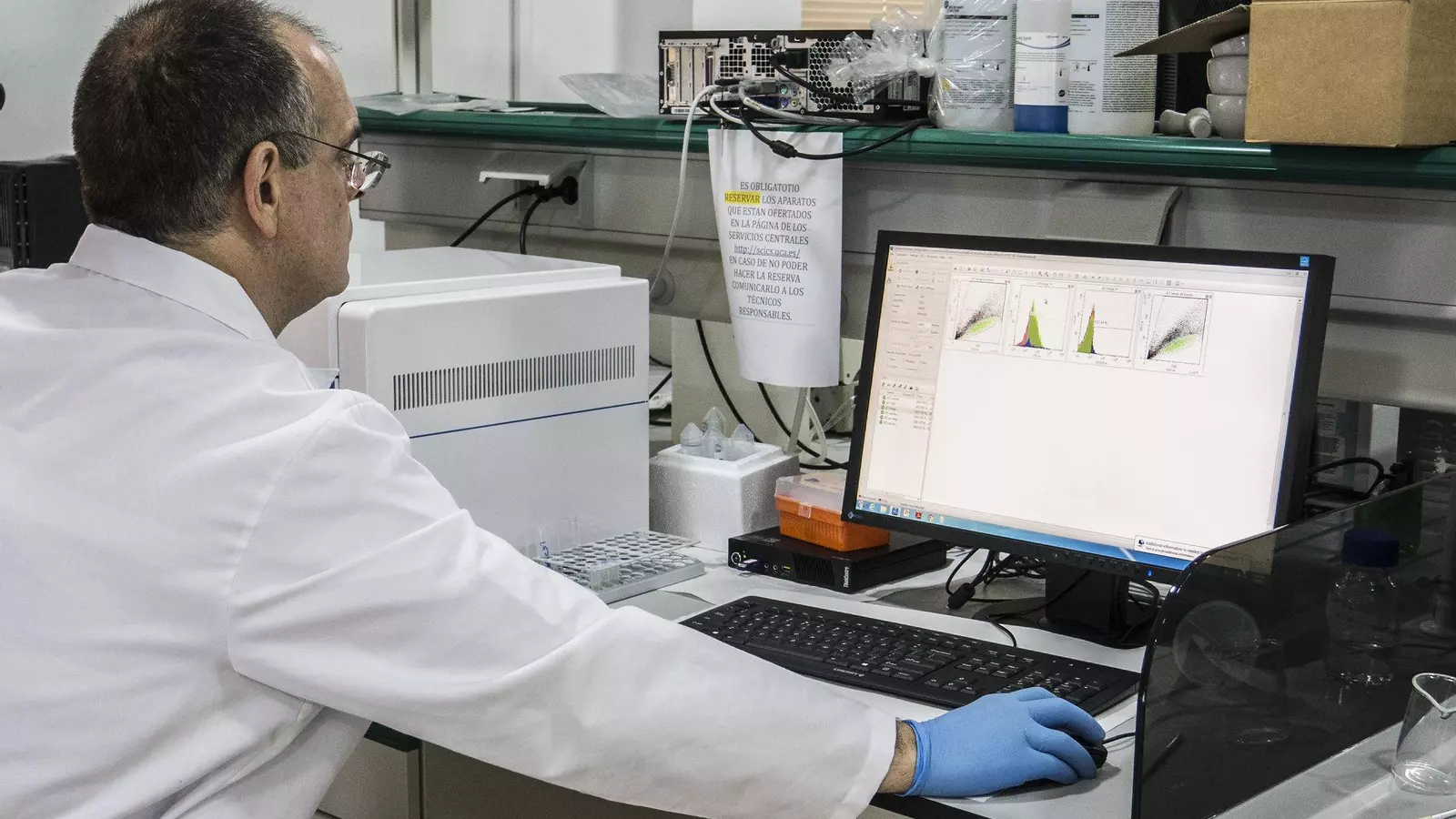


The rapid tests developed by the UCA and the Institute for Biomedical Research and Innovation would not only detect the virus but also the molecules that block it.
Researchers from the University of Cádiz and the Institute for Biomedical Research and Innovation at Cádiz (INiBICA), coordinated by Francisco García Cózar, professor of immunology in the Department of Biomedicine, Biotechnology, and Public Health at the UCA, have launched a research project focused on the design and development of a rapid test that not only detects COVID-19 but also identifies the antibodies produced by our immune system to defend against it and pinpoints therapeutic molecules that block the virus from binding to its receptor.
This project will be carried out thanks to a grant of 100,000 euros from the Carlos III Health Institute, awarded to the Foundation for the Management of Biomedical Research at Cádiz, of which INiBICA is a part.
To understand the importance of early detection of neutralizing antibodies against the coronavirus, it is important to keep in mind that “if a virus infects a cell, it is because it has a protein on its surface that acts as a key to enter the cell through its receptors (the lock) and replicate inside it.” SARS-CoV-2, or COVID-19, uses the same lock as SARS-CoV, a virus that caused Severe Acute Respiratory Syndrome (SARS) in China in 2003, with the important difference that “COVID-19 binds to its receptor 20 times more strongly, which partly explains its higher level of transmissibility and the importance of knowing which antibodies can break that bond,” as Professor García Cózar maintains.
The test proposed by this group of scientists is intended to be very fast; however, to make it even faster, “we are working in parallel on a model based on nanosensors that anyone can use at home,” explains Dr. Daniel Ortega, a researcher at the UCA and a member of the “ Team ” of scientists working on this project. This test will follow the same principle as the first one, but the difference will lie in the use of a nanosensor that can be connected to any smartphone to read the result and send the data to the relevant health authorities. In the event of a future epidemic, this will help reduce the strain on hospital services and provide real-time information on the actual number of infected individuals. In this case, the nanosensor is the result of a collaboration with the research group led by Daniel Ortega, who recently joined the University of Cádiz and works in the Department of Condensed Matter Physics.
Objective: To block the virus from binding to its receptor
The antibodies that have been detected—and that may help in the fight against the coronavirus—are present in patients who have recovered from the disease, but also in people who have never even been sick (asymptomatic) or who have had only very mild symptoms. “These people may have antibodies that are most effective at destroying the virus or blocking its binding to its receptor, which is why they never even got sick,” explains researcher García Cózar.
Thus, detecting antibodies is useful not only for determining who has already been in contact with the virus and who is out of danger, and to determine the actual number of people infected during the epidemic, but also to identify which individuals may have effective antibodies in their serum, “which will allow us to use serum donated by those individuals to treat critically ill patients and also to identify the DNA that codes for those antibodies so we can produce them in the laboratory and turn them into drugs,” in the words of Dr. García Cózar. The fact is, “not all of us produce antibodies that are equally effective against a given infection; that is why it is important to identify those individuals who have produced antibodies that bind very strongly to the virus and, above all, those that block the virus from binding to its receptor, because they would block the virus’s ‘key’ from opening the cell’s ‘lock.’” This is also one of the advantages of the detection system designed by this group of scientists.
Similarly, this Team of scientists—experts in immunology—explains that “when a virus enters our body, the immune system sometimes overreacts and causes collateral damage. In COVID-19, collateral damage to the lungs is responsible for much of the deterioration; that is why some severely ill patients are being treated with anti-IL-6, a drug used for autoimmune rheumatic diseases.” Based on these findings and considering that this group of researchers has been working for years on the development of “chimeric” receptors—which, rather than destroying recognized targets, reduce that destruction— “we will also work on adapting the virus-targeting receptors for a dual function, allowing them to switch from a mode of destroying infected cells to a mode of inhibition, in cases where the immune response becomes excessive.”
Más información: Diario de Cádiz