


Este equipo, coordinado por el catedrático Francisco José García Cózar, trabaja con el propio receptor del virus, que “sigue siendo efectivo para las distintas cepas a pesar de las mutaciones”
Investigadores pertenecientes a la Universidad de Cádiz y al Instituto de Investigación e Innovación Biomédica de Cádiz (INIBICA), coordinados por el catedrático de Inmunología, Francisco García Cózar, del departamento de Biomedicina, Biotecnología y Salud Pública de la UCA, llevan trabajando desde la pandemia (inicialmente financiados por el fondo COVID del Instituto de Salud Carlos III) en el desarrollo de un tratamiento alternativo para COVID que pueda aplicarse, con algunas modificaciones, a otras pandemias que se desarrollen en el futuro y, en general, a enfermedades infecciosas graves.
En los momentos iniciales de una nueva infección, como fue el caso de la COVID-19, y hasta que se desarrollan las vacunas y otras terapias específicas, como los anticuerpos monoclonales, “nos encontramos sin herramientas para salvar la vida de los pacientes susceptibles, entre los que se incluyen los pacientes inmunodeprimidos”, como explica el primer autor del trabajo Pablo González García.
Ante este hecho, este equipo de expertos comenzó a trabajar en adaptar para la COVID la tecnología CAR-T (receptores quiméricos de antígeno en células T), que se está usando con éxito para tumores y que consiste en fabricar una construcción de ADN que permita utilizar lo mejor de los dos tipos de inmunidad de la que disponen nuestras defensas: la basada en anticuerpos y la inmunidad celular. “Estos CAR utilizan un fragmento de anticuerpo para identificar las células tumorales y otras estructuras para hacer que los linfocitos T (un tipo de glóbulos blancos) maten las células tumorales”.
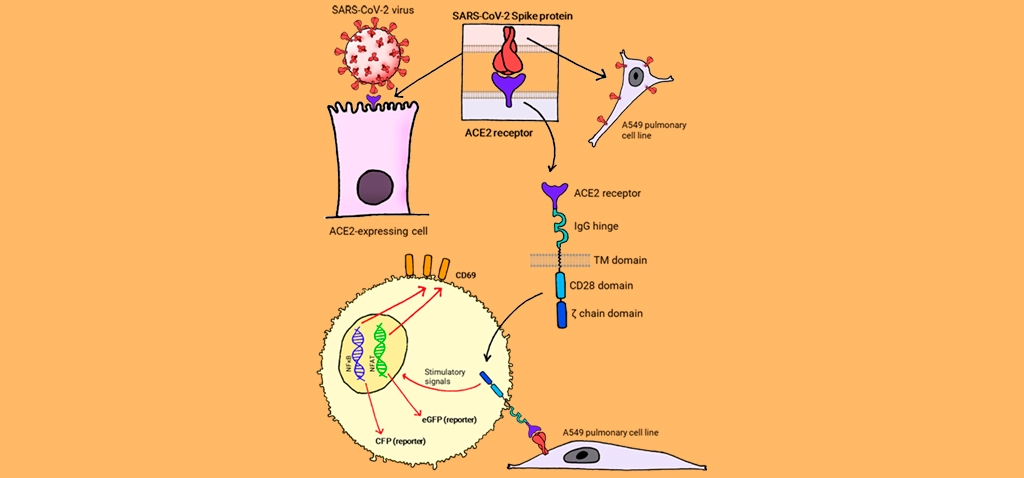
El grupo dirigido por el doctor García Cózar, en lugar de utilizar un fragmento basado en anticuerpos para reconocer las células infectadas por el virus, han utilizado el propio receptor del virus, ACE2, que “tiene la ventaja de que sigue siendo efectivo frente a las distintas cepas a pesar de las mutaciones que pueda sufrir un virus, porque todos ellos tienen que ser capaces de unirse al receptor para infectar las células y, por tanto, tendrán que seguir encajando con este receptor señuelo que en vez de dejarse matar, lo que hará será eliminar las células infectadas, impidiendo que el virus se desarrolle en su interior”.
Por otro lado, y de cara a pandemias futuras, se podrá diseñar un CAR para un nuevo virus en cuanto se conozca su receptor, información que suele estar disponible mucho antes de que se desarrollen anticuerpos monoclonales efectivos o vacunas.
Además del desarrollo de esta terapia, estos expertos en inmunología sostienen que “cuando un virus entra en nuestro organismo, el sistema inmune a veces se pasa en su celo y produce daños colaterales”. En la COVID-19, “esos daños colaterales en el pulmón son responsables de gran parte del deterioro que se produce en los pacientes graves, por eso se están tratando algunos enfermos con anti citoquinas y corticoides, fármacos que se usan en enfermedades reumáticas autoinmunes”. A partir de estos hechos y teniendo en cuenta que este grupo de investigadores lleva años trabajando en el desarrollo de receptores ‘quiméricos’ que “en lugar de destruir lo reconocido, disminuyan esa destrucción, vamos a trabajar también en adaptar los receptores contra el virus, a una función dual, que permita cambiar de un modo de destrucción de células infectadas a un modo de inhibición, en los casos en que la actividad del sistema inmune resulte excesiva”.
Referencia bibliográfica: González-García, P.; Muñoz-Miranda, J.P.; Fernández- Cisnal, R.; Olvera, L.; Moares, N.; Gabucio, A.; Fernández-Ponce, C.; García-Cozar, F. (2023): ‘Specific Activation of T Cells by an ACE2-Based CAR-like Receptor upon Recognition of SARS-CoV-2 Spike Protein’. Int. J. Mol. Sci. 24, 7641. https://doi.org/10.3390/ijms24087641.
🔗 More information: UCA
