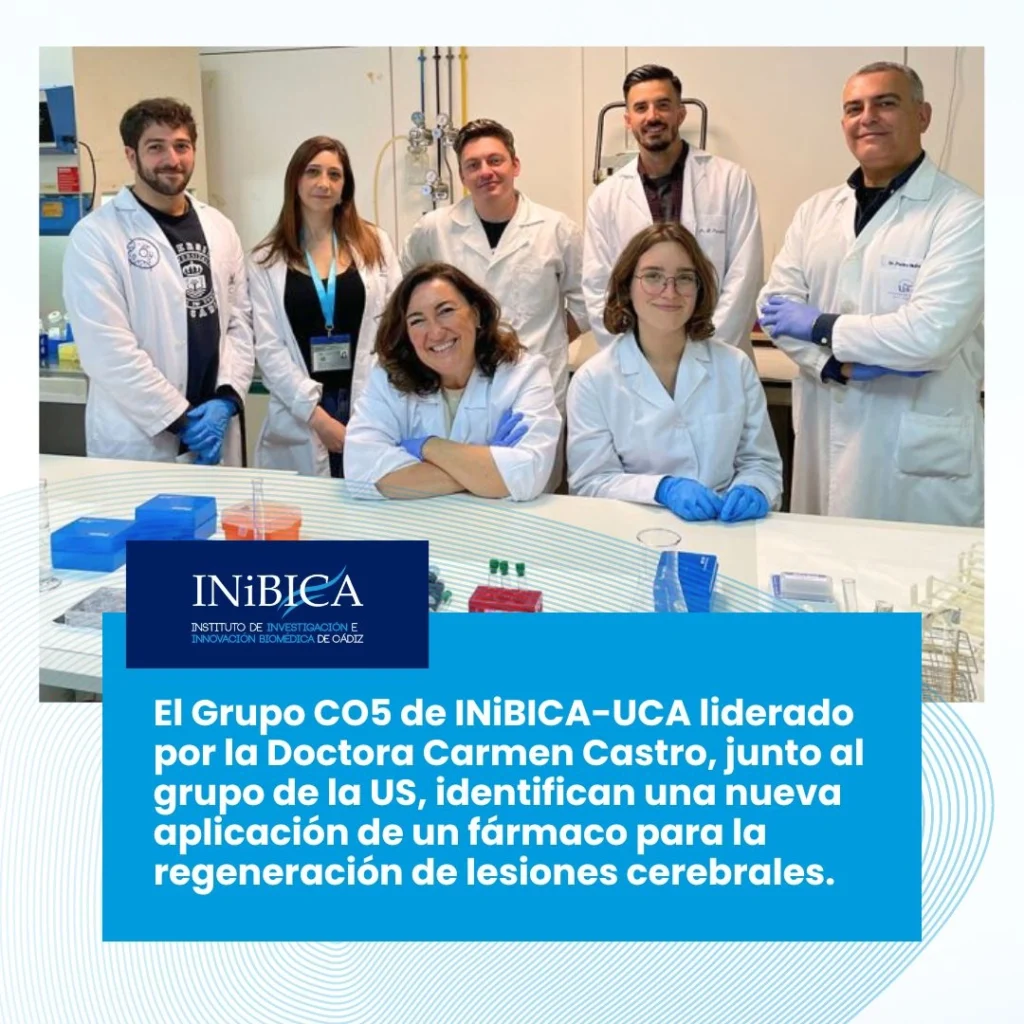
This important discovery, made in mice and published in the *Journal of Translational Medicine*, focuses on a medication indicated for the treatment of lung cancer. Researchers at the University of Cádiz, led by Carmen Castro, a professor in the Department of Physiology, in collaboration with Professor Pedro Núñez of the University of Seville, have found that a drug currently used to treat lung cancer facilitates the repopulation of brain regions damaged by traumatic injuries with new neurons. This important finding, published in the prestigious international journal *Journal of Translational Medicine* (published by Springer Nature), is the result of a preclinical study conducted on laboratory animals. Brain injuries of various etiologies (traumatic, ischemic, neurodegenerative, etc.) entail, as explained by the re Authors, an irreversible loss of neurons, which can contribute to the development of motor, sensory, or cognitive disorders that, in turn, may ultimately trigger personality changes or even death. There is currently no effective treatment for this type of brain injury; therefore, the search for therapies that help regenerate damaged tissue and prevent loss of function is one of the challenges facing modern science. It is within this context that the scientists who made this discovery at the Andalusian university are conducting their research. Thus, this study takes as its starting point the fact that a receptor protein found on the surface of cells (EGFR)—which plays a role in various stages of neuron generation—is present at very high levels in injured brain regions. Blocking its activity with this drug facilitates the replacement of damaged brain tissue with new neurons in experimental animals. Thus, in this published study, the researchers have demonstrated that following an injury, the generation of new neurons from stem cells is naturally activated in the so-called neurogenic zones of the brain (where new neurons are generated). However, these cells do not migrate physiologically to the injured regions. Treatment with this drug in mice that have suffered a brain injury allows these newly generated neurons to migrate to the injured area, where they will repopulate the tissue that had suffered a loss of neurons due to the injury. In other words, “treatment with this drug has enabled the injured part of the mice’s brain—which had lost the ability to generate neurons—to receive new neurons from areas that retain the capacity to generate new neurons (where neural stem cells are found),” as explained by the UCA. This new breakthrough opens up the possibility that, “in the future, after conducting additional trials to verify that the drug has the same effect in humans, it may come to be used in regenerative therapies for brain injuries.” Bibliographic reference: Gómez-Oliva R, Geribaldi-Doldán N, Domínguez-García S, Pardillo-Díaz R, Martínez-Ortega S, Oliva-Montero JM, Pérez-García P, García-Cózar FJ, Muñoz-Miranda JP, Sánchez-Gomar et al. (2023): “Targeting the epidermal growth factor receptor to recruit newly generated neuroblasts in cortical brain injuries.” Journal of Translational Medicine, 21: 867. DOI: 10.1186/s12967-023-04707-1. 🔗 More information: UCA