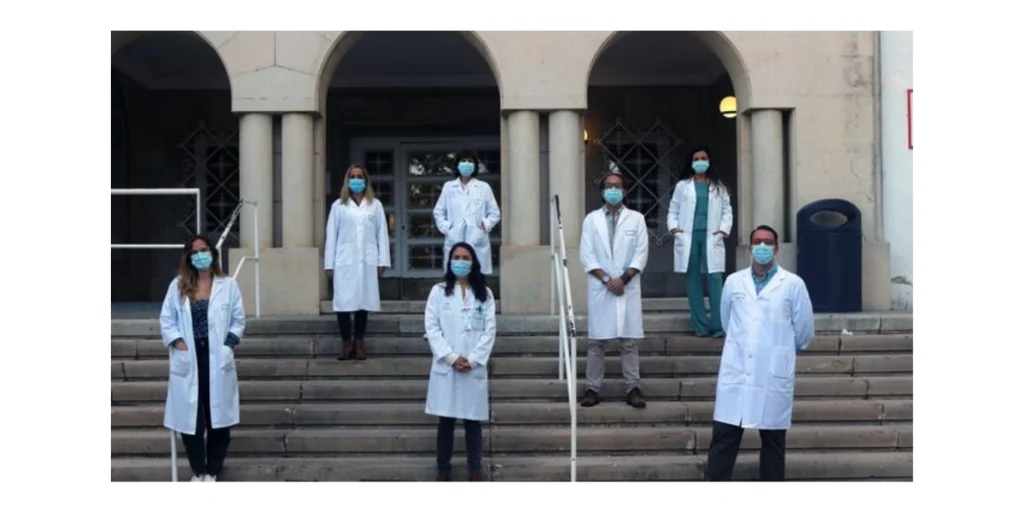
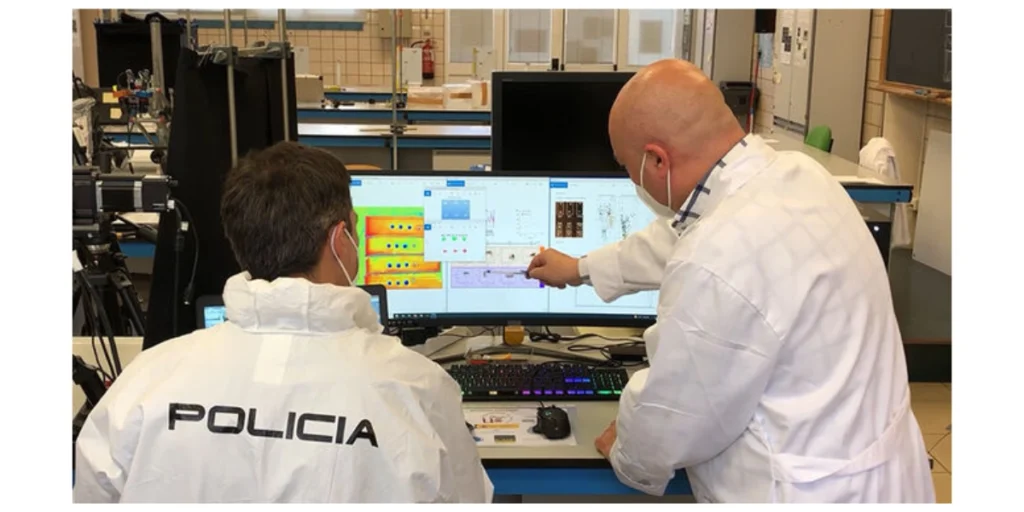
Los investigadores Francisco García Cózar y Lucía Olvera Collantes, del grupo de Inmunología Molecular e Inmunoterapia Génica y Celular del INiBICA ha sido los encargados de generar los virus sintéticos Esta nueva herramienta ha permitido detectar el SARS-CoV-2 en exudado de pacientes sintomáticos con una sensibilidad del 100% y especificidad del 87.5%. Un equipo de investigadores españoles, coordinado por la Universidad de Sevilla (US), ha publicado los primeros resultados de detección del coronavirus causante de la Covid-19 mediante una nueva tecnología óptica. Esta herramienta sería potencialmente utilizable como método de cribado masivo, rápido y fácil de implementar. Esta nueva tecnología, cuyos primeros resultados se recogen en la revista Scientific Reports, del grupo Nature, ha obtenido resultados en la detección de SARS-CoV-2 en exudado nasofaríngeo de personas sintomáticas (las mismas muestras usadas en una prueba PCR) con una sensibilidad del 100% y una especificidad del 87,5%. También se ha conseguido detectar la presencia de SARS-CoV-2 en saliva fresca de personas asintomáticas, así como detectar, diferenciar y cuantificar dos tipos de virus sintéticos (lentivirus y coronavirus sintéticos) en dos tipos de biofluidos (solución salina y saliva artificial). La principal ventaja de esta nueva tecnología con respecto a la PCR radica en la rapidez del procesado de las muestras y en la capacidad que tiene el sistema óptico para analizar de forma simultánea un elevado número de muestras. Los autores del estudio advierten que estos resultados aún deben considerarse con cautela, ya que constituyen una ‘prueba de concepto’, con números relativamente reducidos de casos, en condiciones parcialmente controladas de laboratorio. Por ello, actualmente trabajan en la validación de esta nueva tecnología en condiciones genéricas, incluyendo nuevas variantes del virus y los efectos de las vacunas. Este trabajo es resultado del proyecto C-CLEAN, financiado por el Instituto de Salud Carlos III (Ministerio de Ciencia de Innovación), en la Convocatoria de Emergencia de Proyectos de Investigación sobre el SARS-CoV-2 y la enfermedad Covid-19. Los investigadores comenzaron estudiando la detección de contaminación de superficies, pero este objetivo se reorientó hacia un método de detección de la presencia de virus en los fluidos humanos a medida que el conocimiento científico sobre el virus SARS-CoV-2 y la enfermedad Covid-19 fue avanzando y se determinó que el mecanismo de contagio relevante era el aéreo. La nueva técnica desarrollada detecta virus en gotas líquidas y residuos secos depositados sobre superficies, mediante el uso de imágenes hiperespectrales y el procesado de datos basado en estadística avanzada e inteligencia artificial. Permite el procesado rápido de múltiples muestras simultáneamente, sin contacto con las mismas ni necesidad de reactivos y con un equipo relativamente sencillo, utilizable por personal con una mínima formación. Para ello, utiliza equipamiento óptico estándar desarrollado de manera que pueda ser implementada en entornos con recursos reducidos. La técnica ha sido patentada y los autores están analizando diversas opciones para que pueda ponerse en marcha de forma rápida y asequible. Además de validar los resultados obtenidos, los investigadores continúan trabajando al máximo ritmo para estudiar la aplicabilidad a otros tipos de virus y pasar de una tecnología de cribado a una tecnología de diagnóstico. Asimismo, pretenden realizar pruebas en espacios de gran aglomeración de personas, como aeropuertos y otros centros de transporte, o eventos masivos. También, aspiran a desarrollar una versión de su tecnología adecuada para su uso en teléfonos móviles. La idea del método y el diseño del sistema es del investigador principal, Emilio Gómez González, catedrático de Física Aplicada de la Escuela Técnica Superior de Ingeniería de la Universidad de Sevilla, donde dirige su Grupo de Física Interdisciplinar (GFI), investigador del Grupo de Neurociencia Aplicada del Instituto de Biomedicina de Sevilla (IBIS) y colaborador del Proyecto HUMAINT del Joint Research Centre (JRC). El proyecto C-CLEAN ha sido desarrollado por 30 investigadores de 11 instituciones nacionales, con un marcado componente andaluz, y con apoyo de las instituciones europeas. En concreto, los participantes han sido la Universidad de Sevilla como coordinadora de la investigación, además del Grupo TEDAX-NRBQ del Cuerpo Nacional de Policía, la Red Andaluza de diseño y traslación de Terapias Avanzadas (RAdytTA), el Instituto de Biomedicina de Sevilla (IBIS), el Centro Astronómico Observatorio de Calar Alto (CAHA) (Almería), el Hospital Universitario Virgen del Rocío (Sevilla), el Hospital Universitario Virgen Macarena (Sevilla), el Instituto de Astrofísica de Andalucía, IAA-CSIC (Granada), el Universidad de Cádiz-INIBICA, la Corporación Tecnológica de Andalucía (CTA), con el apoyo del Proyecto HUMAINT del Joint Research Centre (JRC) de la Comisión Europea. Además, se ha contado con la colaboración de tres empresas: Cambrico Biotech, SAMU, y el Centro Educacional Residencial Dr. Gregorio Medina Blanco. Los investigadores Francisco García Cózar y Lucía Olvera Collantes, del grupo de Inmunología Molecular e Inmunoterapia Génica y Celular del INiBICA ha sido los encargados de generar los virus sintéticos. En el Proyecto ha tenido una participación muy destacada el Grupo TEDAX-NRBQ de la Policía Nacional en todas sus actividades, tanto científicas como logísticas y operativas. Los fundamentos y los primeros resultados de aplicación a la detección de otro modelo sintético del SARS-CoV-2 fueron publicados el pasado mes de agosto de 2021 en la misma revista. El Proyecto C-CLEAN ha supuesto un gran desafío científico y tecnológico que se ha llevado a cabo en un tiempo muy reducido (15 meses), desde abril de 2020 a agosto de 2021, en las circunstancias extraordinariamente difíciles derivadas de la pandemia COVID-19. Es una investigación muy compleja en el que los resultados han sido sometidos a una evaluación rigurosa y prolongada (6 meses). Esta investigación es el Proyecto COV20/00080 financiado por la Convocatoria Extraordinaria de Proyectos de Investigación sobre el SARS-CoV-2 y la enfermedad COVID-19 del Instituto de Salud Carlos III, Ministerio de Ciencia e Innovación (MCIN). Este Proyecto es parte de la Ayuda EQC2019-006240-P, financiada por MCIN y “FEDER Una manera de hacer Europa”. Uno de los investigadores ha recibido una Ayuda AEI RTI2018-094465-J. Esta tecnología ha sido seleccionada por el Programa Extenda (Junta de Andalucía) de Aceleración de Empresas de Biotecnología y Tecnologías Sanitarias, 2022. Para más información: Dirección de Comunicación de la Universidad